
Monroe County Owner Record Today
Start with the Monroe County PVA qPublic page for a current owner check. Its certified tax-roll data ties ownership to the parcel's legal description, valuation, photograph, and sketch. The displayed owner is genuinely useful. Remember what it is, though: an assessment record, not a title opinion. Before leaving the screen, save the parcel identifier. Save the assessment year, the retrieval date, and the exact owner spelling. Those details let the deed records at the recording office test that lead.
| Displayed owner | The party named in the PVA ownership field for the selected tax roll. |
|---|---|
| Assessment date | Kentucky fixes tax ownership and assessment as of January 1. |
| Mailing address | The place used for tax correspondence, not proof that the owner lives there. |
| Situs address | The location label for the land or improvement being assessed. |
| Parcel and alternate ID | Database keys used to match the PVA result with the deed and map. |
| Legal description | A summary clue that must be compared with the full deed language. |
An owner of record is simply the party a public record names as owner. That label proves nothing about who lives in the house. A mailing address proves nothing either. Farms, trusts, estates, and companies often receive mail somewhere else entirely. Monroe County qPublic also cautions that sale dates, sale prices, and property characteristics go unverified. Ownership, legal descriptions, and valuations are believed accurate. Read the record card as a dated set of leads. Treat it as leads rather than a profile of a person. The official Monroe PVA landing page lists which parcel-card details are available.
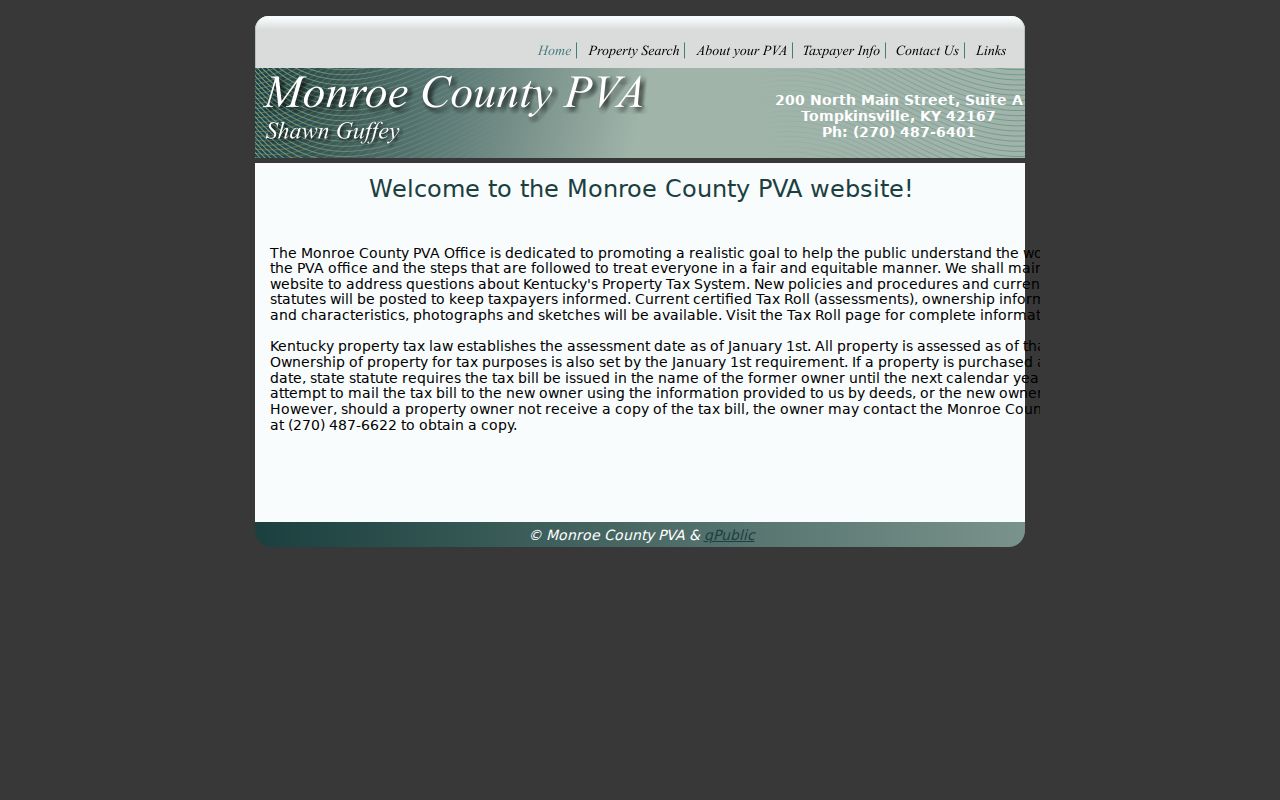
The qPublic notice encourages pairing the owner field with the parcel's tax-roll context, photograph, sketch, valuation, and legal-description clue.
Monroe County's January 1 Rule
Kentucky sets ownership for property-tax purposes on January 1. That single rule explains most stale-name confusion. When a parcel sells later in the year, the tax bill can stay in the former owner's name until the next calendar year. The PVA may draw on deed and new-owner data to route the bill to the buyer, yet the printed tax name can still lag behind.
So put the tax year beside the bill name. Put the recording date beside the deed grantee. A later recorded deed is often stronger evidence of the current owner than a bill keyed to January 1. If a bill never arrived, qPublic points the owner to the Monroe County Sheriff at (270) 487-6622 for a copy.
Date the answer. A post-January 1 buyer may be the deed grantee while the former owner remains on that year's tax bill.
Verify Monroe County Deed Vesting
The Monroe County Clerk keeps deeds, mortgages, leases, liens, releases, plats, wills, and other land records. The newest deed names the grantor, the grantee, and the instrument type. It also shows a recording date, plus a book/page or instrument reference. Vesting means the words that state how title is held. Those words may name one person. Or they may name several people, a trust, an estate, or a legal entity.
Monroe residents can use the private-citizen eCCLIX route. It provides free, Monroe-only personal searching, capped at five searches per day. Gather the owner spelling, parcel identifier, and a likely date range before spending that allowance. The clerk publishes no first year for online Monroe deed records. A blank online result therefore points back to the clerk's counter. It may also point to a written request, or to the older deed books.
Confirm Monroe County Ownership
Keep each source in its lane. Use qPublic to identify the parcel and its displayed owner, then use the Clerk's index to locate the last transfer. Compare both legal descriptions instead of trusting a same-name hit. Splits, combinations, corrections, and partitions can leave an old parcel reference stuck to a newer tract.
- Search qPublic by address, owner, or parcel and record the exact parcel and alternate ID.
- Note the displayed owner, tax year, situs label, mailing field, and legal-description summary.
- Search eCCLIX for the newest deed affecting that land, then capture parties, type, date, and book/page.
- Match the deed description and prior-deed reference to the PVA parcel before stating who owns it now.
- Owner of record
- The party named by a particular official record on a stated date.
- Vesting
- The deed language describing who takes title and how that title is held.
- Grantee
- The person or entity receiving the interest in the recorded transfer.
- Registered agent
- An entity's official process contact, not necessarily the land's beneficial owner.
Monroe County Entity Owners
When the owner field names a company, preserve the full legal name exactly. The Kentucky Business Entity Search accepts an entity name or organization number. It can filter to active entities. It may show status, formation history, principal-office details, filings, and a registered agent. Those details help explain the named grantee. They still do not replace the deed.
A trust or estate calls for a different path. A trustee's or administrator's role is not individual ownership. Probate filings, wills, affidavits of descent, and fiduciary deeds may show how an interest moved. Current court information starts with CourtNet. The Monroe Circuit Court Clerk at the Justice Center keeps the local files. Attach the role, source, and record date to every name you record.
Resolve Monroe County Record Conflicts
When the PVA, the tax bill, and the deed disagree, do not pick the easiest name. Resist choosing the name that is simplest to reach. Start with the January 1 rule. Then compare parcel keys and land descriptions. A correction deed can change the trail. So can a partition, a combination, or a probate transfer. The PVA can explain an assessment field. The Clerk can supply the recorded instrument itself.
The PVA sits at 200 N. Main Street, Suite A, Tompkinsville, and answers at (270) 487-6401. The County Clerk is in Suite D at the same address, at (270) 487-5471. Clerk requests may be delivered, mailed, emailed, or faxed. They should identify the record precisely. Written requests for nonexempt records under the Kentucky Open Records Act generally get a response within five working days.
Note: Request a parcel-linked assessment explanation plus the latest deed reference. Include the exact owner spelling and a useful date range.
Contact a Monroe County Owner
For a property matter, the public mailing field is the measured path. It may fall outside Monroe County. It proves no one's residence or occupancy. Safe at Home participants can substitute a state address on public records. So a masked mailing location may be deliberate. Copy as little as needed. Never publish more personal data than the property question requires.
Lawful use. Use Monroe County owner information only for legitimate property research or contact. Never use it to stalk, harass, intimidate, or harm anyone.