
Monroe County Property Value Types
Four figures usually shape a Monroe County valuation review. Kentucky law requires locally assessed real property to sit at 100 percent of estimated fair cash value, after exemptions, agricultural-use rules, and other classifications. That standard sets the target for the assessor. It does not make any displayed number a guaranteed sale price.
| Value | What It Is | Where |
|---|---|---|
| Assessed value | The PVA's tax-roll estimate under Kentucky's fair-cash standard | Monroe PVA/qPublic |
| Fair-cash or market estimate | The price the property might bring in a fair voluntary sale | PVA analysis or an appraisal |
| Last sale price | Consideration from a prior transfer, with date and transaction limits | Recorded deed; qPublic as an unverified lead |
| Taxable assessment | Assessment remaining after a valid exemption or special valuation | PVA tax roll |
One parcel can show all four figures without any contradiction. Assessment and sale dates may differ, a sale may not be arm's length, and an exemption can lower the taxable base while the underlying estimate holds. Write the year beside every number.
ASV in Monroe County qPublic
The Monroe PVA site draws its certified tax roll. It covers a wide range of details: ownership, legal description, valuation, photographs, sketches, and property characteristics. You can search by owner name, address, parcel number, or an alternate ID. The ASV field is the assessed-value figure. Record it alongside the assessment year. Note that the official Monroe PVA page also lists the office's stated limits on its data and tax roll. Check those notes before relying on any single value.
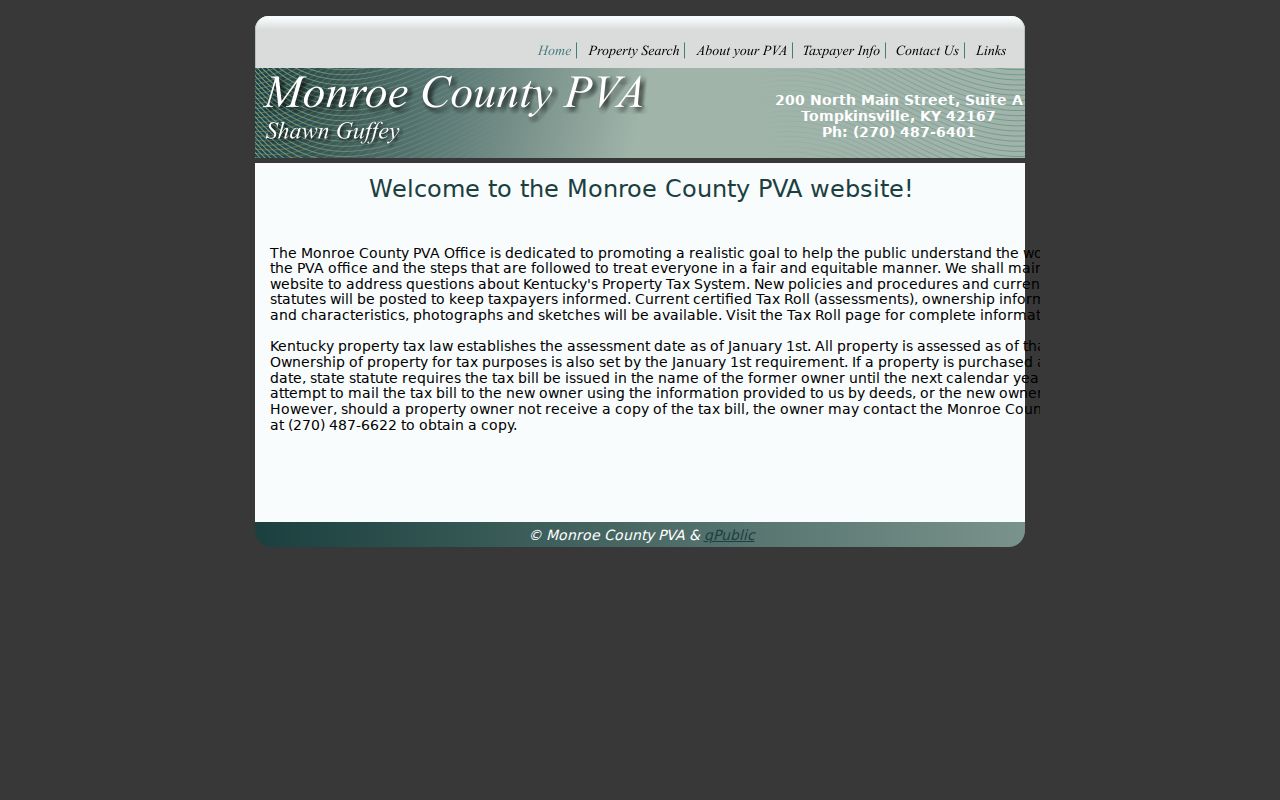
The qPublic entry page is a starting point. It is also a policy source. A live parcel result is still needed for one address. The PVA adds a caution. Ownership, legal description, and valuation are believed accurate, but sale price, sale date, and property characteristics are not verified and may contain errors. Treat those fields accordingly when comparing values. Sales data in particular deserves independent confirmation.
Note: Save the result date, parcel key, assessment year, and disclaimer whenever you quote a Monroe County property value.
How Kentucky Values Monroe Property
The Kentucky Department of Revenue lays out three standard approaches. Sales comparison weighs comparable transfers. The cost method weighs replacement cost and depreciation. Income capitalization weighs what a property can earn. A PVA picks the method that fits the parcel's class and facts. Revaluation happens every year. Each parcel must also get a physical inspection at least once every four years. A change between assessment years can reflect new market evidence. It can also reflect construction, condition, classification, or a scheduled review. Guesswork explains nothing. Ask the PVA which field supports the figure.
Check a Monroe County Property Value
Preserve the number and its context. Address alone can mislead in rural areas. Use the exact address when it is stable, but keep the parcel or alternate ID as the stronger database key, because rural names and postal places vary.
- Search the address or parcel in Monroe PVA/qPublic and confirm that the legal description fits.
- Capture ASV, tax year, exemption or classification fields, and the page's update date.
- Find the recorded deed through the County Clerk and transcribe its consideration and recording date if shown.
- Compare like dates and explain any classification, exemption, or non-market transfer before calculating a ratio.
- Assessed value
- The PVA's value for the stated assessment year.
- Fair cash value
- Kentucky's estimate of a fair voluntary sale price.
- Sale consideration
- The transfer amount stated in a deed, when present.
- Assessment ratio
- Assessed value divided by a verified sale price for stated dates.
- Reassessment
- A new valuation for a later tax-roll year.
Compare Monroe County Value Dates
An assessment-to-sale ratio is a simple calculation. Divide the assessed value by a verified sale price. Show both numbers and both source dates. A ratio built on an old sale and a new assessment says little about current worth. The same weakness appears when a transfer was between relatives, part of an estate, or covered more than one tract.
Do not treat qPublic's sale-history field as verified just because it sits beside the ASV. Confirm consideration in the County Clerk's recorded instrument. The clerk's eCCLIX index and courthouse counter are the proper sources, and the earliest online coverage year is not published.
Exemptions Change Monroe Taxable Value
A qualifying exemption can push taxable value below assessed value. Kentucky's homestead or disability exemption covers an eligible owner. The owner must own, occupy, and maintain the home as a personal residence on January 1. The 2025-2026 maximum is $49,100. Check the live amount and eligibility for the year used. Agricultural-use valuation is another reason a simple comparison can mislead. Rural land may be valued under the statutory farm program. That differs from ordinary home-sale comparison. Keep classification, exemptions, and the base assessment as distinct fields.
Monroe County's January 1 Quirk
Ownership is fixed on January 1. Close on a Monroe County purchase later in the year, and the tax bill may still carry the seller's name until the next calendar year. The PVA may try to send the bill to the buyer using deed information. The printed name can still lag. This quirk does not change the value definition. It can still confuse a parcel review. Pair the PVA owner and assessment year with the deed date and the billed name. If a bill goes missing after a purchase, the PVA directs the owner to the Monroe Sheriff at (270) 487-6622.
Correct a Monroe County Value Field
Address value-field corrections to the Monroe PVA at 200 N. Main Street, Suite A, Tompkinsville. The office also takes correction questions by phone at (270) 487-6401. Include the parcel and alternate ID plus the assessment year. Name the exact field in dispute. Attach the supporting record, whether a deed, photograph, sketch, or other document.
When the dispute is with the assessment itself, Kentucky sets a formal conference and appeal path during the tax-roll inspection period. That track runs through the Monroe County property tax records. A value review here should stop at naming the source figures and documenting them.
Access Monroe County Assessment Records
The online qPublic route is fastest. Monroe County PVA counter, phone, fax, and email channels serve as fallbacks. Use them for map products, historical questions, corrections, and fields that will not display. A sharply identified map or data request can also go to Kentucky DOR Mapping Services.
Sale-side records work differently. Query deeds and transfers through County Clerk eCCLIX. Visit the Suite D counter, or send a written request by hand, mail, email, or fax. Identify the names, date range, instrument type, parcel or legal description, and the copy wanted. Clerk copy fees are payable in advance. Note that the recording schedule is not a certified-copy price list.
Limits of Monroe County Property Value
A Monroe County assessed value is an official tax-roll figure for a stated year. It is not a promise the parcel will sell for that sum. Title defects and easements sit outside the number. So do repairs, financing terms, and unusual sale circumstances. Private conditions matter too. The qPublic sketch does not prove a boundary.
Buyers and sellers may bring in an independent licensed appraisal and current market evidence. A deed gives a recorded transfer price when stated, not today's market answer. Keep each figure labeled. One number should not silently replace another.
Value versus price. A Monroe County assessment supports taxation. It is not a sale forecast or an independent appraisal.