Home › Property Tax Records
Monroe County property tax records never sit in a single office. That surprises most people. The PVA sets the assessment. The sheriff bills and collects. The County Clerk takes over anything delinquent. One lookup rarely finishes the job. Start by pairing the parcel number with the tax year. Assessed value, exemptions, the billed name, and payment status each answer a different question. None of them alone proves a sale price or a transfer of title. Read them side by side before concluding anything.
Talk with the PVA or a deputy first. Many disputes end there. If yours does not, file with the County Clerk no later than one workday after the inspection period closes and state the claimed value. Bring factual value evidence, since the local three-member Board of Assessment Appeals hears the matter 25 to 35 days after the close and the PVA presents its own support. The decision arrives by certified mail.
Appeal window. Kentucky's inspection period generally runs for two weeks beginning the first Monday in May, but local notices can alter dates. Verify the current calendar.
Ownership on the Monroe County tax roll is set on January 1. A buyer's deed records later in the year. The buyer can still see the former owner's name on that year's bill. The PVA tries to mail the bill using new deed information. The tax-roll name may not change until the next calendar year.
Keep the deed date, the PVA assessment year, and the bill year side by side. That way a simple timing rule is not mistaken for a title conflict.
The state's official page lists a $49,100 homestead or disability exemption for 2025 through 2026. Qualifying takes more than ownership. The owner must meet the age or total-disability rule and must own, occupy, and maintain the property as a personal residence on January 1. One exemption covers each household. An eligible buyer has to reapply after a sale.
The Kentucky homestead page shows the current program with an example.
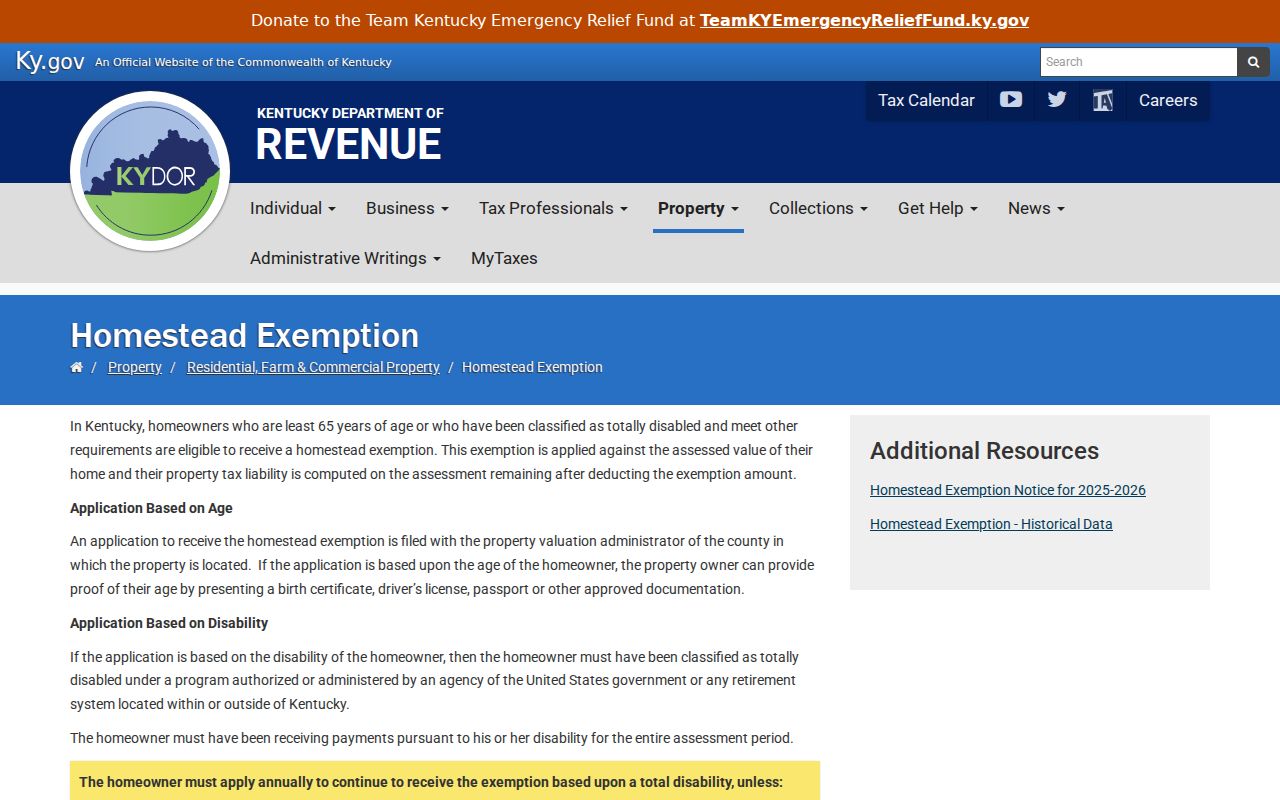
Confirm the year's exact amount with the Monroe PVA, then submit the applicable form with support.
April 15 is the cutoff. At close of business that day, unpaid bills move from the county sheriff to the county clerk. Certificates are created on or about April 16. Each one becomes a recorded lien. Interest then accrues every month. The clerk's page currently lists a September 23, 2026 sale at 1:00 p.m. Central Time, a date to recheck before relying on it.
The official delinquent-tax notice explains the handoff and the current sale details.
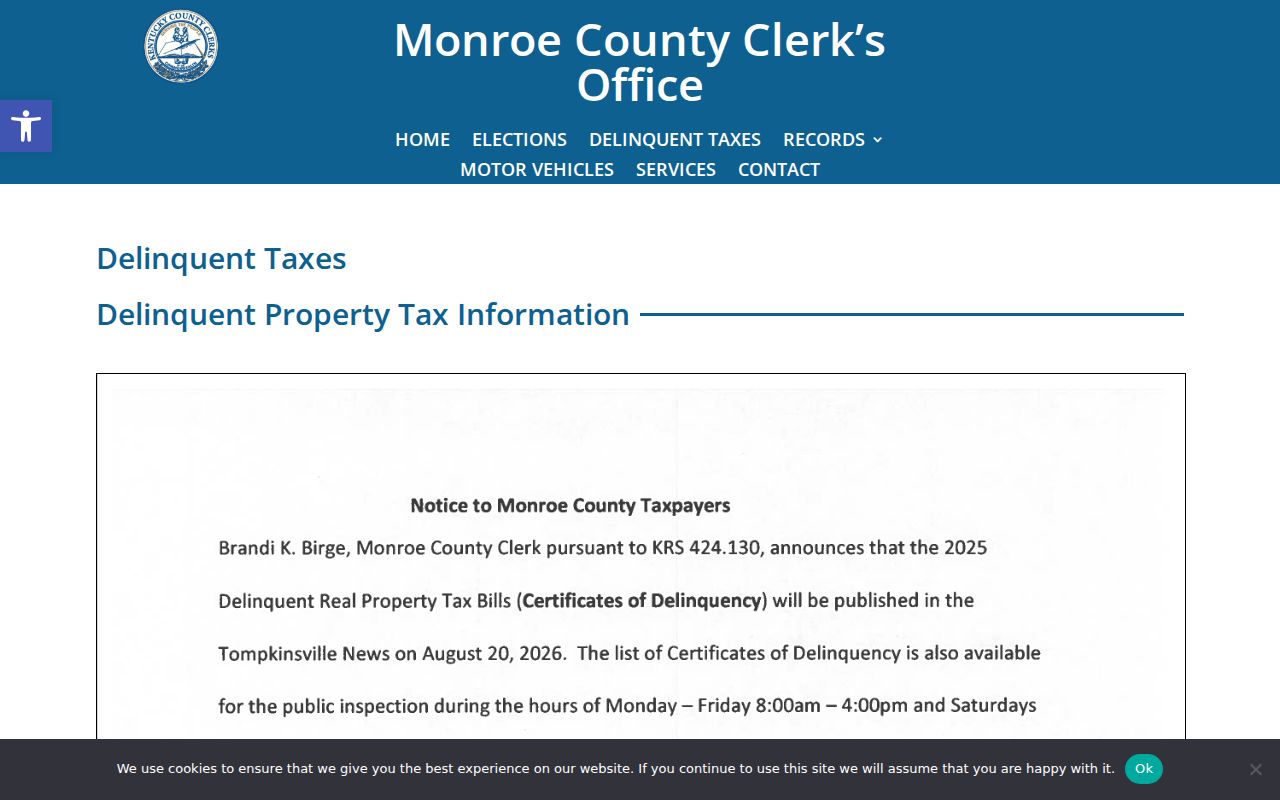
Buying a certificate is not a tax deed. It creates no title by itself. Check redemption, enforcement, releases, and any later conveyance before drawing a conclusion.
Assessment and correction questions go to the PVA, online through qPublic or in person, by phone, fax, or email. Current bill copies come from the sheriff. The clerk's counter handles identified certificates and recorded instruments by phone, written request, mail, email, or fax. Payment-plan questions go to the County Attorney at (270) 487-5568, though certificates already sold stay ineligible.
Name the exact record. The Kentucky Open Records Act reaches existing records, so describe what you want precisely. KRS 131.190 can shield confidential tax information. Ask for the parcel assessment, the bill, the certificate, or the sale list rather than private return data.
The Kentucky Department of Revenue requires annual revaluation of real property. Physical inspections come at least once every four years. Within the fair-cash-value framework, the PVA may lean on sales comparison, cost, or income methods. Those methods back an assessment. That is still not a private appraisal.
Save both assessment years when a value changes. Keep the parcel characteristics, any classification, and the source date too. Farm land can receive agricultural-use treatment. Other statutory classifications or exemptions can skew a simple comparison. Ask the PVA about the exact field instead of inferring a cause from a rural address.
The PVA conference comes first. It must happen during the inspection period, with the PVA or a deputy. Bring the parcel record. Bring the owner's claimed value, dated photographs, a list of factual errors, and any relevant sales or valuation evidence. Know what the dispute is about. Each calls for different proof. The issue may be land, improvements, characteristics, classification, or an exemption.
No agreement means a County Clerk filing. The filing must arrive by the deadline and state the claimed value. The Board of Assessment Appeals hears both sides. A later appeal follows the route printed on the mailed decision. Dates can shift when the inspection calendar is delayed or specially advertised. Confirm the live Department of Revenue and local notices.
A delinquent certificate is a lien of record. Third parties can buy it. The purchase itself conveys nothing. A sound record note asks several questions in order: whether the bill transferred, whether the certificate was purchased, whether payment or redemption occurred, whether enforcement reached court, and whether a deed or release later recorded.
The September 2026 sale notice is a current event, not a permanent rule. Save the page date. Recheck it before any publication or action. Prior-year certificates may already have sold, so the clerk's live status and the recorded chain matter more than an old sale listing.
Good note-taking makes a Monroe County property tax record trustworthy. Keep the parcel number, tax year, and assessment year together. Add the billed name and any exemption. Include the amount or status field, the retrieval date, and the custodian. When no direct bill portal exists, call that an access gap. That is more honest than a clean answer without a source. A dated, source-specific note beats one undated claim. Never trust a bare claim that taxes are paid, delinquent, or tied to the newest deed holder.
Kentucky's fair-cash-value framework drives the PVA's work. The ASV figure on the screen is still an assessment field, though. qPublic cautions that sale date, sale price, and property characteristics are unverified and may contain errors. The office stands behind its ownership, legal description, and valuation data. Keep those two categories separate whenever a sale becomes appeal evidence.
A recorded deed can carry consideration language. That language still needs context. Family transfers, estate deeds, corrections, and multi-parcel transactions are not arm's-length sales. A ratio only works under one condition. The assessed value and a verified sale price each have documented dates. Label that arithmetic a research calculation. It is not an official appraisal or a tax conclusion.
The taxable assessment can also sit below the headline assessed value. A homestead or disability exemption cuts the value subject to tax for a qualifying household. Agricultural-use valuation and statutory classification can distort a rural parcel comparison. Read the exact qPublic fields. Ask the PVA about any discrepancy instead of guessing from the address or the look of the land.
The sheriff collects ordinary real-property bills during the collection period. On April 15 at close of business, any unpaid bill moves to the County Clerk. A certificate springs up on or about April 16. It becomes a lien of record and accrues monthly interest. The clerk's explanation is clear that the taxpayer stays personally obligated.
Once the transfer happens, record the certificate identifier, tax year, parcel, and listed taxpayer. Add the amount and the date. Include any third-party purchaser and payment-plan status. Note the sale notice and any redemption or payment. Add court enforcement, release, and any later deed. The clerk warns that unpaid certificates can be sold at any time. They may go to a third party. An eligible payment plan is a question for the Monroe County Attorney. A certificate already sold at tax sale does not qualify for that county-attorney plan.
A tax-sale notice marks one point in the process. Nothing more. It does not prove bidding occurred. It does not prove that a certificate remains outstanding. It does not show that redemption expired or that title changed. Confirm current status with the clerk. Then search recorded instruments and court files before drawing any ownership conclusion.
For an appeal, purchase review, or estate file, accuracy matters. Get the current record straight from its custodian. Save the staff response and retrieval date beside the parcel and year. Tax status shifts over time. Treat an undated screenshot or copied list as a lead. The sheriff, clerk, or PVA confirms the layer that matters.
Sponsored Results
