Home › Property Search
The right Monroe County property search key depends on what you already know. An address, owner name, or parcel number each opens a different door. Some keys fit one record better. A deed index follows the legal transfer. The tax roll and assessor data tell you who gets the bill. Monroe County keeps these sources separate on purpose. Search Monroe County property records by address, owner, or parcel. Save the source date. Keeping situs, mailing, ownership, and title facts distinct prevents a normal timing difference. That habit stops it from turning into a false conclusion.
Switch keys when the first search misses. Rural road labels, mailing-place names, and old deed descriptions often disagree with a current Monroe County situs field, so the strongest property search key changes with both what you know and the record you need.
| Search Key | Best For | Where It Works | Watch Out |
|---|---|---|---|
| Address | One known site | qPublic | Rural road variants |
| Owner name | Assessed parcels or deed parties | qPublic and eCCLIX | Entities and shared names |
| Parcel number | [Exact record match] | [All portals] | [Reformatting between offices] |
Not a title search. A Monroe County property search finds official leads. It cannot guarantee clear title or establish a legal boundary.
Monroe qPublic documents four search keys: name, address, parcel number, and alternate ID. Copy the label exactly.
| Input | Use | Carry forward |
|---|---|---|
| Name | Find PVA listings | Exact displayed spelling |
| Address | Locate situs record | Parcel and alternate ID |
| Parcel | Reopen known tract | Hyphens, decimals, zeroes |
| Alternate ID | Try a second locator | Reference number and STR |
The PVA search acceptance page leads into qPublic.
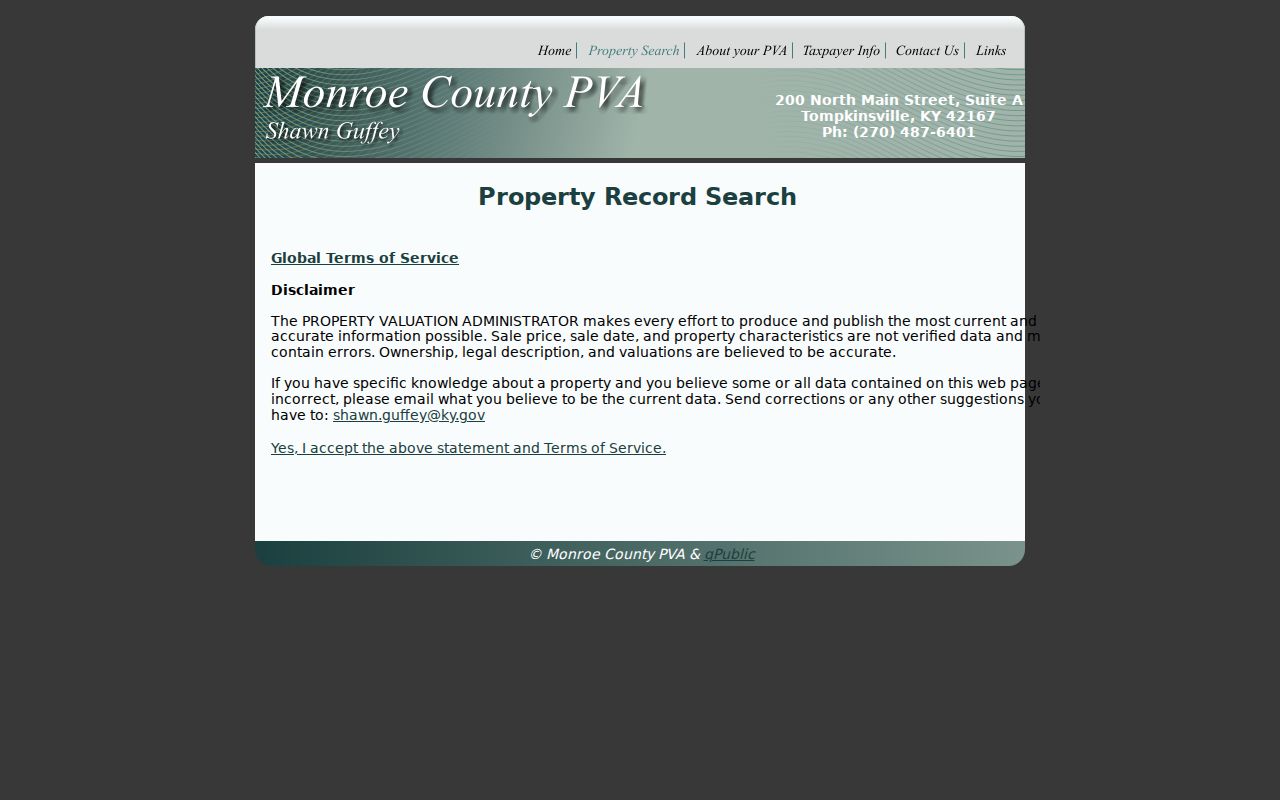
Read its disclaimer before carrying a sale or characteristic into a final note.
Kentucky sets ownership for assessment purposes on January 1. A deed recorded later in the year can leave the newest grantee out of sync with the name on the tax roll until the next assessment cycle. The PVA mails tax bills using deed information where available. Questions about a missing bill go to the Sheriff at (270) 487-6622.
Owner of record means the source's owner display. Situs locates the land, mailing address carries notices, and parcel ID is the database key, not the legal description.
Official sources publish no starting year for Monroe County's earliest eCCLIX records. A blank online result proves nothing. Ask the County Clerk directly. The office takes counter, phone, mail, email, fax, and written requests; ask for the earliest online and counter-only volumes, then continue through KDLA inventories, microfilm, and the William B. Harlan Memorial Library.
Expect surprises in Monroe County owner names. An estate, trust, or company can appear where a personal name was expected, and court and entity indexes do not convey land; the recorded deed controls. The Kentucky Business Entity Search adds context.
A careful Monroe property search keeps deed, PVA, and tax results in separate columns, since each source updates on its own schedule. Start with the recorded deed. Save the grantor, grantee, recording date, instrument or book/page, consideration, legal description, prior reference, and any exceptions. The qPublic record answers other questions. From it, keep the displayed owner, assessment year, ASV, parcel and alternate ID, situs, mailing address, sketch or photo, and any disclaimer. The tax source needs its own line. Record the bill year, billed name, certificate status, payment or sale status, and custodian. Then label the outcome. Call it a clean match, a post-January-1 lag, an estate or entity naming difference, a legal-description mismatch, or a clerk instrument still needed. That label keeps an unresolved issue visible. It stops a mailing address from becoming a residence claim or an assessment field from passing as the latest recorded title in Monroe County property records.
Monroe County mailing places include Tompkinsville, Gamaliel, Fountain Run, Hestand, and Mount Hermon. A ZIP code is only a filter. Postal names can cross or miss an incorporated boundary. When an address property search fails, try the road name without directional text, the owner's exact and variant spellings, the parcel or alternate ID, and the deed's community or legal-description terms. Older deeds often lack a modern situs address. Work forward instead. Grantor and grantee entries, adjoining-owner calls, acreage, landmarks, a prior book/page, and any plat reference can carry you to the right Monroe parcel. Keep every spelling exactly as the source shows it. Search tools normalize data differently, and changing original punctuation can hide a valid match.
eCCLIX permits five free personal searches per day through Monroe's residential route. Plan before you log in. Prepare a sheet with the current displayed owner and a likely former owner. Add entity spellings, a deed date window, and a parcel or legal-description clue. Run both directions. Where the system permits, search grantor and grantee separately. The same person can appear on opposite sides of different transfers. Open every page and exhibit. Do this when the entry shows an image page count. Quote the locator in a clerk request when no count appears. Never spend the final search repeating one spelling. A surname variant, entity suffix, or prior owner could test a better theory in your Monroe property search.
Field corrections in qPublic, ownership-display questions, and map products all belong with the Monroe PVA at 200 N. Main St., Suite A, Tompkinsville, (270) 487-6401. Historical assessment questions belong there too. The office also takes fax and email inquiries. Include the parcel number, the assessment year, and the exact field. Add the deed or other source supporting the correction. Deeds, plats, liens, releases, and wills sit with the County Clerk in Suite D at the same courthouse address, (270) 487-5471. Other recorded instruments sit there too. The clerk accepts hand-delivered, mail, email, and fax open-record requests. State the requester details the office requires and describe the precise record you need. Fees must be paid in advance. Court files go to the Monroe Circuit Court Clerk at the Justice Center, 300 N. Main St., (270) 487-5480. CourtNet and Judicial Indexes supply case leads, while the local clerk holds the copies. For a tax bill copy, call the sheriff. Routing each question by record type saves time. It also keeps one office from having to interpret another office's data.
Keep a log that makes any Monroe County property search repeatable. Record the portal used. Note the search key, the exact spelling, the retrieval date, and the result locator. Add the assessment or record date. Include a brief note on what the source itself says. Save an image or PDF when the portal allows. Transcribe the stable numbers too: book/page, instrument number, parcel ID, or case number. Dynamic result links can expire, so the identifiers matter more than the link.
Conflicts belong on separate lines, never merged into one owner or one value. List the qPublic owner with its assessment year. Add the newest deed grantee with its recording date. Include the tax-bill name with its year, and any estate or entity role. Then mark what still needs a clerk instrument, a case file, or a PVA explanation.
When qPublic points to a likely parcel, use the displayed owner as one eCCLIX party search. Use the legal-description text as a match test. A name match without the same tract is not enough. Pull the deed's grantor, grantee, recording date, and document type. Also pull the instrument or book/page, consideration language, full description, prior deed reference, and exceptions. When the goal extends past the latest transfer, search the prior grantor as an earlier grantee. Residential eCCLIX serves personal, noncommercial Monroe research and caps a user at five searches per day. That ceiling rewards careful preparation. Try exact and variant spellings. Keep entity suffixes intact. Search both sides of a transfer when the interface allows. When a record has attached images, eCCLIX help notes that a page count can appear alongside the book/page entry. Open the entire document, since an exhibit may hold the complete description. If a result lacks an image, send the locator to the clerk. The published fee table lists recording charges for filing new instruments, not a universal copy charge. Ask the price of a plain or certified copy and whether archive retrieval adds a cost. That keeps a property search focused on retrieval. It avoids turning the recording schedule into a wrong estimate.
Monroe County publishes no standalone GIS viewer. It documents no adjacent-parcel tool either. qPublic is the practical online start. One official filing reproduced qPublic material. It showed parcel examples 18-45, 18-46, and 18-45.01 along with a photo, sketch, living area, porch, garage, and nearby-sales content. Those values illustrate one dated regulatory filing. They are not a countywide parcel-number rule or a promise about every live result.
Copy any parcel value exactly, hyphens, decimals, and leading zeroes included. A suffix may reflect a database relationship; the Monroe PVA documents no meaning for it. If a number fails, try the alternate ID. You can also try a reference number, STR, owner, address, or legal description. Do not reverse-engineer the local coding scheme.
Kentucky DOR Mapping Services is the fallback. It takes map and digital data requests routed through the PVA. State the county. Give the layer or field, the data date, the format, and the scope. Say whether ownership is requested. Its guidance marks PVA maps for identification only, not conveyance. For serious boundary work, the deed, the recorded plat, and a licensed survey control.
Public access does not make every field wise to republish. A mailing address is where notices go. It may sit outside Monroe County. It is not proof of residence or possession. A situs address identifies land but can be incomplete on an old rural tract. Kentucky Safe at Home lets eligible participants use a substitute Secretary of State address in state and local public records. Voter files are included.
Keep personal details to a minimum in any research note. Preserve the land locator, record date, instrument or parcel reference, and office. Also preserve the narrow fact the property question needs. Do not build a person profile from unrelated public files. If a protected or substitute address appears, leave the program alone. Do not work around it through other records.
For an apparent qPublic error, send the Monroe PVA the parcel, the exact field, and the assessment year. Send the supporting deed too. For an instrument question, contact the County Clerk. Correction and redaction rest with the custodian and the law requiring the record. Access to a filing creates no right to alter it.
Sponsored Results
